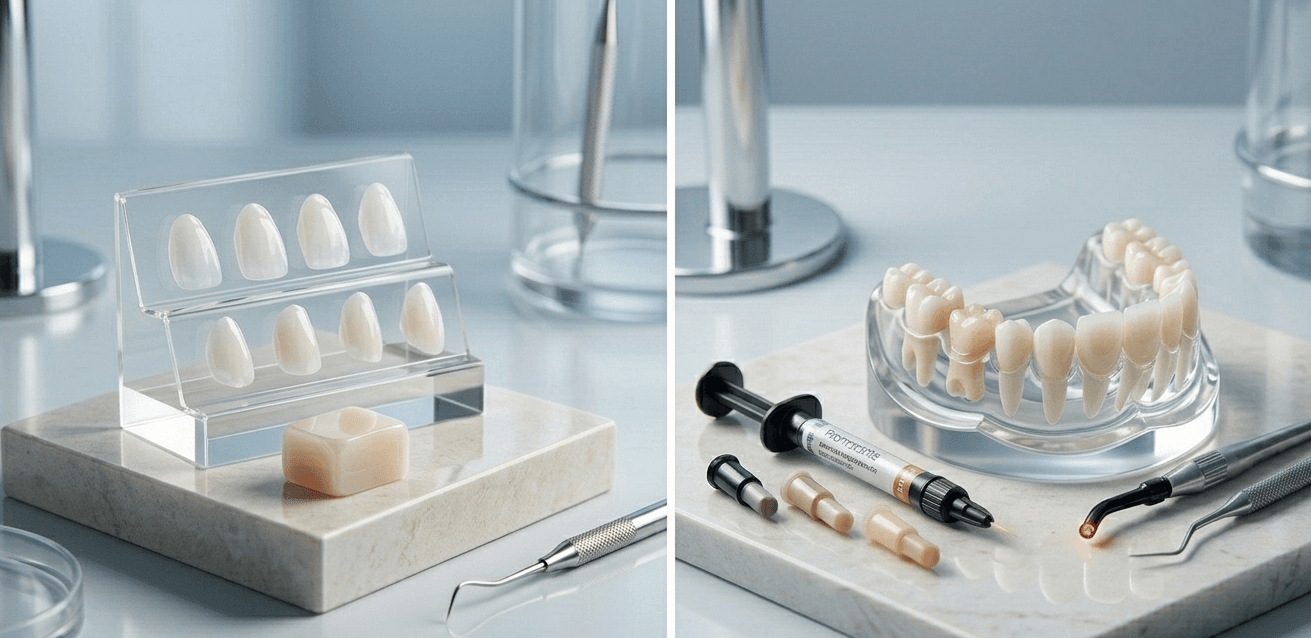
1. Price and Overall Cost
The initial financial investment is often the first factor patients consider.
- Porcelain Veneers: Considered a premium treatment, porcelain veneers typically range from $925 to $2,500 per tooth in the U.S. While the upfront cost is higher, their longevity often makes them a better long-term investment.
- Composite Resin Veneers: This is the more budget-friendly option, generally costing between $250 and $1,500 per tooth. It allows patients to achieve a beautiful smile at a lower immediate price point.
2. Quality and Material Composition
The structural makeup of the veneers dictates how they perform in the mouth over time.
- Porcelain: Made from high-grade, biocompatible ceramic. The material is fired in a laboratory kiln, resulting in a glass-like, incredibly strong structure that seamlessly bonds to the natural tooth.
- Composite Resin: Made from a tooth-colored mixture of plastics and glass fillers. It is the same material used for cavity fillings. While high quality, it is inherently a softer and more porous material than ceramic.
3. The Natural Look: Which Looks More Authentic?
Both materials look great, but if the absolute most natural appearance is your goal, there is a clear winner.
- Porcelain: Porcelain wins the "natural look" category. Natural tooth enamel is translucent, meaning light passes through it. Porcelain mimics this light-reflecting property perfectly, giving the veneers a vibrant, lifelike depth.
- Composite Resin: Composite is slightly more opaque. While modern resins have improved significantly, they do not capture and reflect light quite as dynamically as natural enamel or porcelain, sometimes looking slightly flatter in comparison.
4. Visual Appeal: Which Looks Better Over Time?
It is not just about how the veneers look on day one, but how they look on day one thousand.
- Porcelain: Because porcelain is baked with a permanent glaze, it retains its high-gloss, pristine appearance for its entire lifespan. It will look just as good a decade later as it did on the day it was placed.
- Composite Resin: Composite looks excellent initially, but the surface can lose its luster and become dull over the years, requiring professional polishing to restore its shine.
5. Resistance: Stains and Chipping
Your diet and habits will interact differently with these two materials.
- Porcelain: Highly resistant to staining. You can drink coffee, tea, and red wine without fear of discoloring the ceramic. It is also exceptionally strong and highly resistant to chipping and scratching.
- Composite Resin: Being a porous material, composite will absorb stains over time, much like natural teeth. It is also a softer material, meaning it is more susceptible to chipping if you bite down on hard foods or ice.
6. Durability and Expected Lifespan
Veneers are not permanent, but their lifespans vary greatly.
- Porcelain: With proper brushing, flossing, and regular dental visits, porcelain veneers reliably last 10 to 15 years, and frequently last upwards of 20 years.
- Composite Resin: Because the material is softer and prone to wear, the average lifespan of composite veneers is between 5 and 7 years before they need to be entirely replaced.
7. Maintenance Frequency and Associated Costs
Understanding the hidden costs of upkeep is crucial.
Porcelain:
- Frequency: Very low. They require the same maintenance as natural teeth (brushing, flossing, and 6-month checkups).
- Cost: Minimal to zero extra cost beyond your standard dental cleanings.
Composite Resin:
- Frequency: High. Because they stain and chip more easily, patients often need touch-ups, surface repolishing, or minor repairs every 1 to 2 years.
- Cost: Repolishing or repairing chipped composite can cost between $100 and $300 per visit, which adds to the long-term total cost of the veneers.
Comprehensive Feature Comparison
| Criteria | Porcelain Veneers | Composite Resin Veneers |
|---|---|---|
| Initial Price (U.S.) | $925 - $2,500 per tooth | $250 - $1,500 per tooth |
| Material Quality | Premium Medical-Grade Ceramic | Engineered Plastic & Glass Resin |
| Durability & Lifespan | 10 to 15+ Years | 5 to 7 Years |
| Maintenance Frequency | Low (Standard 6-month cleanings) | High (Requires routine polishing/repairs) |
| Maintenance Cost | Minimal (No special upkeep needed) | $100 - $300+ periodically for repairs/polishing |
| Visual Appeal | Retains high-gloss shine indefinitely | Can become dull and lose luster over time |
| Natural Look | Exceptional (Mimics natural light translucency) | Good, but slightly more opaque and flat |
| Resistance | Highly resistant to stains and chipping | Porous; susceptible to staining and chipping |
Conclusion
While composite resin veneers offer a faster, more budget-friendly entry point to a smile makeover, porcelain veneers remain the undisputed gold standard in cosmetic dentistry. Their unparalleled natural beauty, permanent stain resistance, and low-maintenance requirements make them the superior choice for patients seeking a durable, long-lasting transformation.